
Mecklenburg Projected Versus Actual Release
North Carolina’s exact public label is Projected Release Date. It is an estimate based on the sentence and credit information then held by the correctional agency. It is not a court order promising release on that day. The later Actual Release Date in sentence history records the completed release event. Always verify that both dates belong to the current sentence and the correct person.
A Mecklenburg County pretrial detainee may have bond terms or a scheduled hearing but no computed sentence-release date. A court order can authorize release, yet MCSO still completes eligibility, outstanding-warrant, property, and transfer checks. For a person serving an activated local sentence, the jail custodian and judgment are the relevant sources. For a state prisoner, NCDAC calculates the public projection.
- Projected Release Date
- The current correctional estimate based on sentence structure and recorded credit.
- Actual Release Date
- The retrospective date in sentence history after custody release occurs.
- Detainer
- A request or hold involving another agency that can affect where a person goes next.
- Custody review date
- An administrative review marker, not a release or parole-review date.
Find a Mecklenburg Release Date
Start with the custody system, not the county of conviction. A Mecklenburg conviction can lead to a state prison elsewhere in North Carolina. Conversely, Detention Center Central is a county jail, not an NCDAC prison. The correct search depends on who holds the person now.
- Check the MCSO Inmate Inquiry for a county record. Use PID or JID when known and inspect status, committed date, sentence rows, and any Released field.
- If the person is serving a state sentence, open the NCDAC Offender Public Information Search. Use the offender number when possible.
- Open the correct detail and compare birth data, county of conviction, sentence begin date, service status, minimum and maximum terms, and punishment type.
- Read Projected Release Date as an estimate. Check sentence history for an Actual Release Date only after the event.
- For a local jail sentence without a public calculation, compare the judgment with MCSO Records and Release or ask for the existing sentence and credit record.
- For federal custody, use BOP’s locator. Do not apply North Carolina earned-time rules to a federal date.
The official NCDAC form displays the filters used to locate a Mecklenburg County state-sentence record.
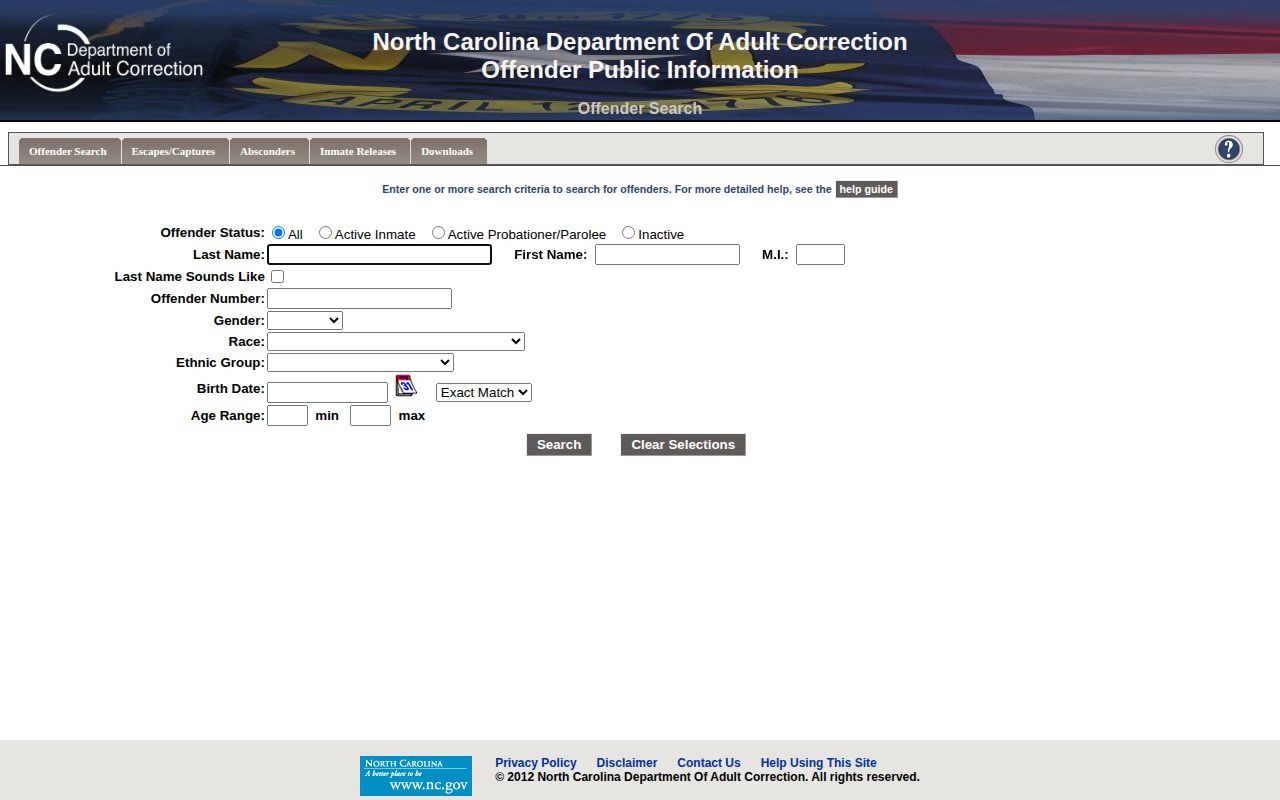
An offender number is faster and safer than a name-only match, while narrow filters may need to be removed if no result appears.
Mecklenburg Structured Sentencing Calculation
For offenses on or after October 1, 1994, North Carolina Structured Sentencing generally requires service of 100 percent of the judicial minimum. Jail credit counts toward that minimum. Earned time from qualifying work or full-time programs can reduce the maximum, but G.S. 15A-1340.13(d) does not let ordinary earned credit reduce the sentence below the minimum.
The Commission’s official explanation describes the structure as at least 100 percent of the minimum and 85 percent of the maximum before felony post-release supervision. That is the accurate form of the often-repeated “85 percent” idea. It does not mean every person gets a 15 percent cut, and it never means serving only 85 percent of the minimum.
The official parole process explanation shows the minimum and maximum framework used in the state calculation.
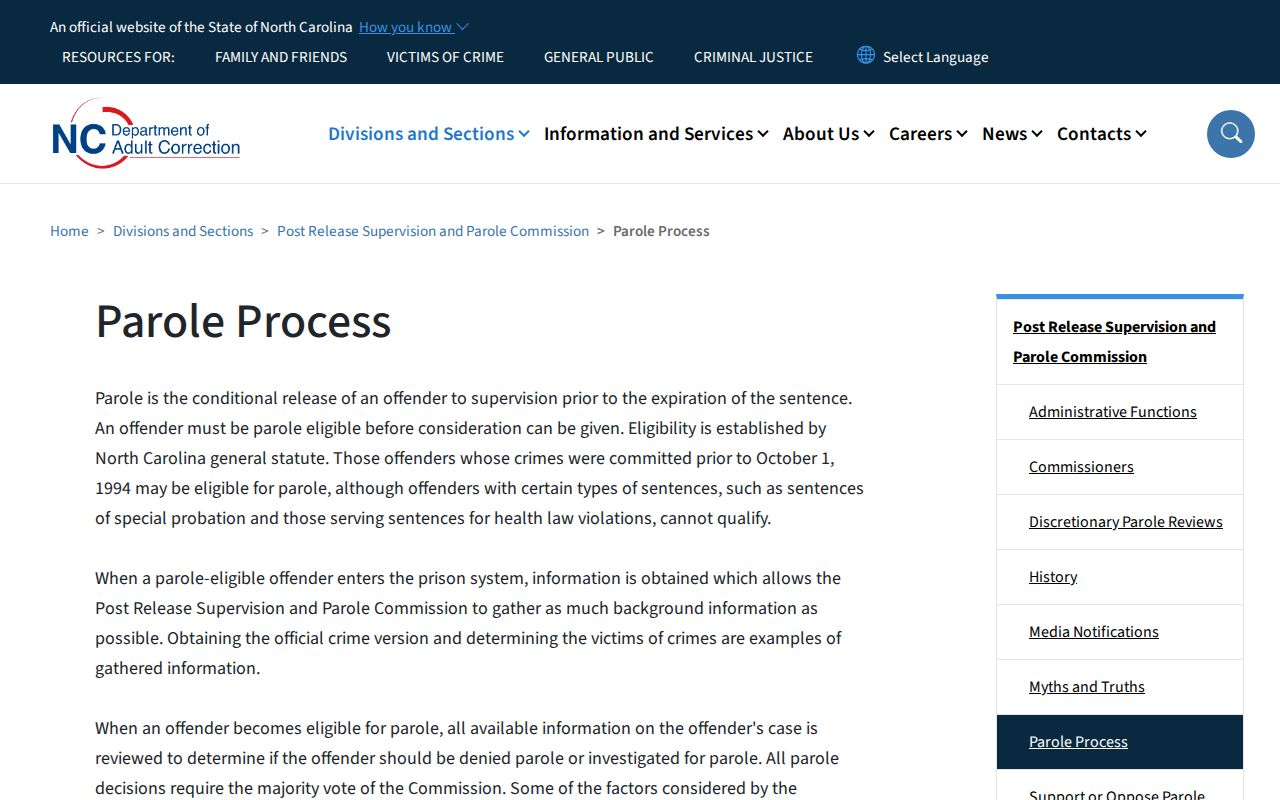
The displayed explanation should be read with the individual judgment and NCDAC sentence detail, not used as a universal arithmetic shortcut.
Note: Earned time can move the maximum toward the minimum, but ordinary structured-sentence credit cannot cross below the minimum.
Mecklenburg Post-Release Timing Rules
Release from prison may begin a supervision phase rather than end the sentence. G.S. 15A-1368.2 generally schedules release to post-release supervision at the maximum less 12 months for Class B1 through E felonies and less nine months for Classes F through I, subject to allowable earned time. Specified sex-offense maximums use a 60-month rule. Article 84A governs that supervision stage.
Post-release supervision starts on the release date. Completion of its lawful period terminates the sentence under the statutory framework. Supervision earned-time reduction is limited to 20 percent of the original supervision period. A state offender record can therefore show an Actual Release Date from prison and still remain active as a probationer, parolee, or post-release supervisee.
Ordinary parole is different. It generally applies to older, parole-eligible offenses and limited statutory exceptions. A parole review or custody review marker is not itself the projected prison-release date.
Local Mecklenburg Jail Earned Time
G.S. 148-13 authorizes NCDAC earned-time rules and requires applicable rules for sentenced local prisoners. For an activated misdemeanor, G.S. 15A-1340.20(d) caps earned credit at four days per month. A public MCSO detail may show sentence begin and end, minimum and maximum, earned time, and credit fields, but it may not expose a full future calculation.
When the date is not shown, request the existing calculation from the custodian and compare it with the court judgment. Identify the person, PID or JID, case, sentence start, and relevant jail stay. Ask for an existing electronic sentence and credit record. North Carolina public-record law does not require the agency to create a new calculation or database report.
A bonded pretrial stay is not an activated jail sentence. Bond, case events, and a judicial release order control that departure. Do not apply misdemeanor earned-time credit to a detainee who has not been sentenced.
Older Mecklenburg Sentence Frameworks
Fair Sentencing applies to offenses from July 1, 1981 through September 30, 1994. NCDAC explains that good time can credit one day for each day of good behavior, subject to forfeiture for discipline, and merit time may also apply. Older parole statutes govern eligibility. The current Structured Sentencing formula should not be copied onto these records.
Advanced Supervised Release is another narrow exception. G.S. 15A-1340.18 applies only when a court orders ASR for an eligible defendant and the required incentives are completed, or cannot be completed through no fault of the defendant. The ASR date is generally tied to the shortest mitigated term. If the court imposed a mitigated-range sentence, the statute describes 80 percent of the imposed minimum. ASR is not automatic.
| Framework | Release-date rule to check |
|---|---|
| Structured Sentencing | Judicial minimum, maximum, earned time, and post-release stage |
| Fair Sentencing | Good time, possible merit time, forfeiture, and older parole law |
| Activated misdemeanor | Local sentence, jail credit, and statutory monthly earned-credit cap |
| Advanced Supervised Release | Specific court order, eligibility, and completion of incentives |
| Federal sentence | BOP calculation and federal credit rules |
Why Mecklenburg Release Dates Change
A projected date is recalculated when the source facts change. Some events move the estimate earlier, while others move it later or change the destination without changing the sentence. The NCDAC detail should be rechecked near the date.
| Change | Possible effect | Best source |
|---|---|---|
| Jail or prior-custody credit | Changes credit applied toward the sentence | Judgment and correctional calculation |
| Earned-time award or forfeiture | Moves the maximum toward the minimum or restores time | NCDAC sentence record |
| Work, program, or discipline change | Can alter qualifying credit | Correctional calculation |
| Resentencing, vacatur, or new order | Changes the legal sentence base | Court and updated NCDAC record |
| Detainer or transfer | May change the next custody destination | MCSO, receiving agency, BOP, or ICE |
| Eligible parole or ASR | Uses a separate authorized release path | Commission, judgment, and NCDAC |
| Federal recalculation | May move a BOP projected date | BOP locator and federal record |
A transfer can populate MCSO’s Released field because county custody ended while the person remained confined elsewhere. That is a custody-routing change, not community release.
Confirm Mecklenburg Actual Release
After the projected day, return to the controlling source. MCSO’s populated Released date and time confirms departure from county custody. NCDAC’s Actual Release Date and inmate status confirm the state prison event. For a federal person, BOP shows a release date and a status such as Released or Not in BOP Custody. None of those labels alone proves that all supervision or other-agency custody ended.
A pending release can also be monitored through VINELink Inmate Search. NC SAVAN offers phone, text, and email notices for supported county and state events. A notice may arrive after a transfer or projected-date update, so confirm it against the source record.
Records and Release at the MCSO Arrest Processing Center is the fallback for an unclear county entry. The operation maintains booking, bond, movement, transfer, and release data. Court records explain the order or judgment but do not establish the minute physical release processing ended.
The NCDAC eligibility screen is one input to the date, while the later correctional detail supplies the record-specific estimate and actual outcome. Recheck both identity and sentence before relying on a date.
Mecklenburg Release Channel Sweep
No single channel covers every person tied to Mecklenburg County. Sheriff Garry L. McFadden's MCSO handles county jail records. The North Carolina Department of Adult Correction handles state prison and community supervision, while the North Carolina Post-Release Supervision and Parole Commission governs the applicable supervision stage. The Clerk holds the court judgment. NC SAVAN provides alerts. BOP controls federal projections, while ICE ODLS covers current and recently released immigration detainees within its limited window.
If the online county record lacks a calculation, use the Mecklenburg County public-record request route and ask for the existing sentence-credit or OMS release record. For state custody, begin with NCDAC and request only the public sentence, admission, time-served, and release fields if the public detail is insufficient. This sequence avoids applying one system’s rules to another system’s date.
The official county request page shows the fallback channel for a missing Mecklenburg jail release calculation.
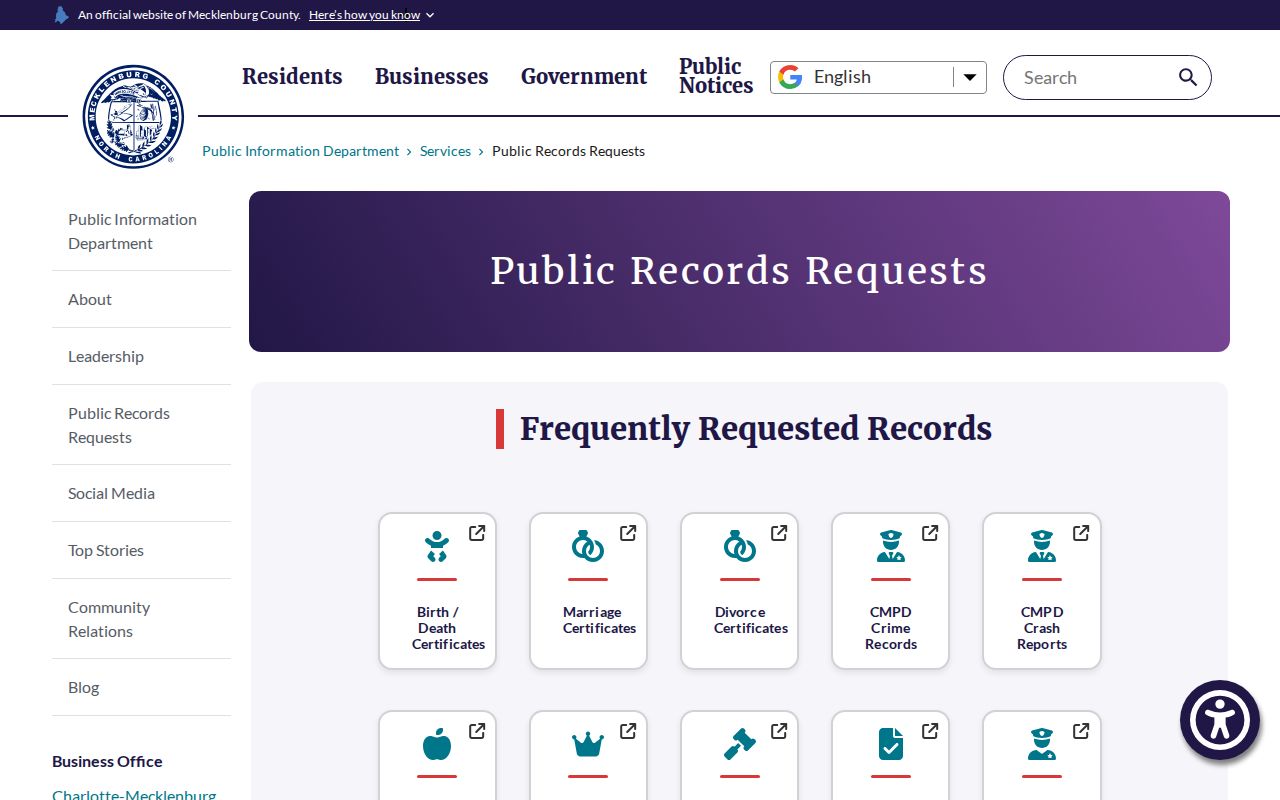
A narrow request should identify the existing record and relevant jail stay rather than demand a newly created projection.
Public Record Search
Sponsored Results