
Mecklenburg County Release Records
A populated Released date and time in the Mecklenburg County Sheriff's Office inmate detail is the clearest online proof that MCSO custody ended. The record can remain visible after the person is gone because the inquiry includes current and historical entries. MCSO describes it as a real-time system with arrest and resident information online for three years from arrest or release. That feature makes the local inquiry more useful than a live roster that shows only people still confined.
Release does not always mean a return home. It can follow bond, a judicial order, time served, a completed local sentence, or another administrative end to county custody. It can also record a transfer to another county, the North Carolina Department of Adult Correction, the U.S. Marshals Service, the Bureau of Prisons, or immigration custody. Read prisoner type, status, the committed timestamp, bond or order data, charge codes, and sentence rows with the Released field. If those details do not make the authority clear, request the underlying Records and Release entry.
The MCSO public inquiry choice screen identifies the official route into resident and arrest searches.
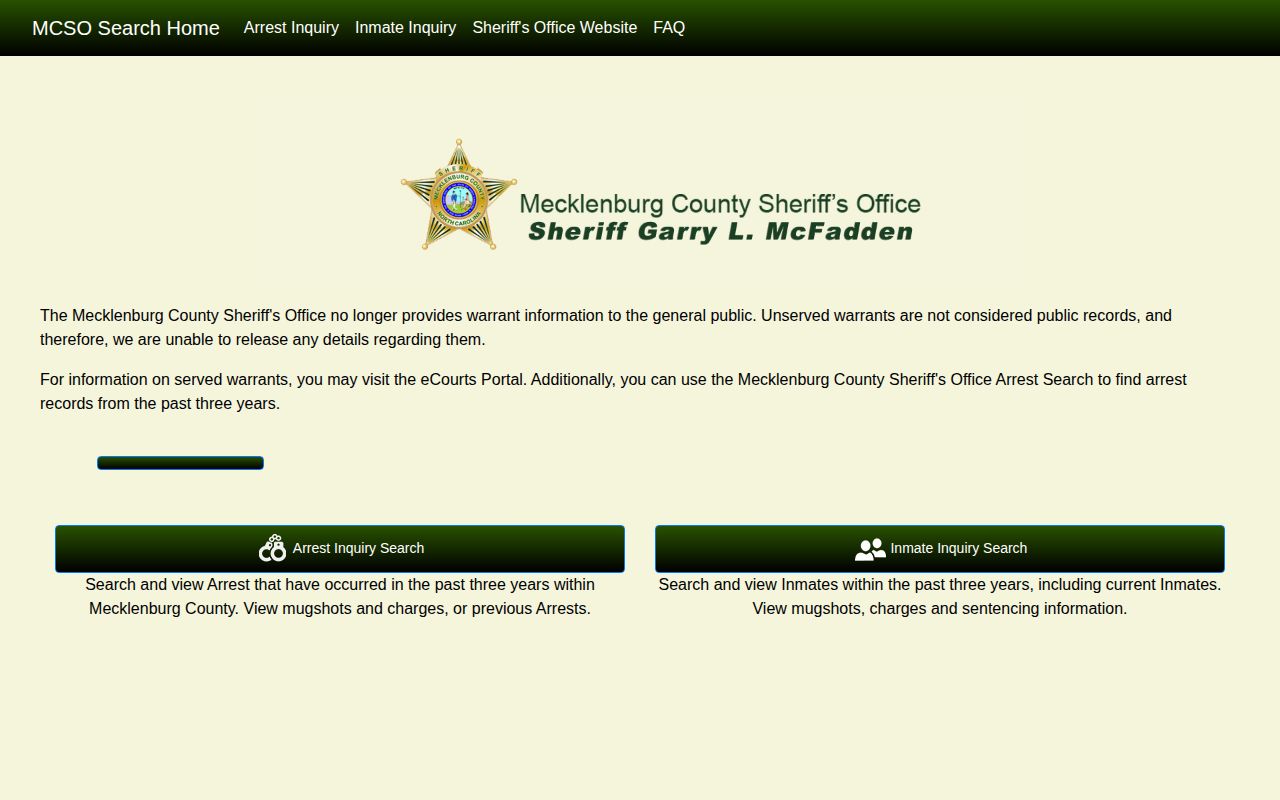
Choose the inmate or resident inquiry for a county custody release; civil inquiry serves a different records purpose.
Mecklenburg County Release Types
The next record to check depends on the kind of departure. A bond or pretrial order ends physical detention while the criminal case remains open. Completion of a county sentence is different from transfer to state prison. A release to probation or post-release supervision also leaves a person in the community under legal oversight. No one code should be read in isolation.
| Release path | What it means | Next record |
|---|---|---|
| Bond or judicial release | County detention ends while the case may continue. | MCSO release field and eCourts case |
| Time served or local sentence | The ordered county confinement has ended. | MCSO sentence and release entries |
| Pretrial supervision | The person leaves jail under court-set terms. | Court order and Mecklenburg Pretrial Services |
| State transfer | MCSO custody ends, but NCDAC custody begins. | NCDAC offender search |
| Federal or immigration transfer | Another sovereign may take custody. | BOP locator, federal docket, or ICE ODLS |
| Probation or post-release supervision | Confinement ends while community oversight remains active. | NCDAC supervision status |
A charge marked bonded is not a final case outcome. Likewise, an inactive county record does not establish dismissal or conviction. Match the release entry with the court case when the reason for departure matters.
Fields in Mecklenburg Release Records
MCSO's detail joins identity, custody, charge, bond, and sentence data around the release event. PID is a fingerprint-linked identifier that follows a person across bookings. JID identifies one jail stay and can change on a later stay. Those numbers are safer than relying on a common name alone. A non-active record with a populated Released timestamp is the strongest local release sign.
| Field | What it shows |
|---|---|
| PID and JID | The person-level fingerprint identifier and the identifier for one jail stay. |
| Prisoner type | County, state, federal, USMS, BOP, ICE, 287G, or another custody category. |
| Committed | When the person entered the recorded MCSO custody episode. |
| Released | The date and time that MCSO custody ended. |
| Bond or order | The release condition or court authority tied to a charge. |
| Charge disposition code | An operational charge status, not a finding of guilt. |
| Sentence rows | Case, sentence dates, term, type, earned time, and credit where recorded. |
Does a Released timestamp mean every case is over? No. It marks the end of MCSO custody for that stay. The case may remain pending, supervision may start, or the person may have transferred to another authority.
Note: Similar names should be matched with PID, JID, birth data, booking dates, and the correct arrest episode before drawing a conclusion.
When Mecklenburg County Releases Occur
Records and Release is part of the Arrest Processing Center inside Detention Center Central and operates around the clock. Staff enter bond and charge changes after court activity, check release eligibility, check for outstanding processes, and document movement out of MCSO custody. Multiple checks can affect how long release takes. MCSO publishes no guaranteed hour at which county residents leave, so a morning-only or evening-only rule would be false.
The local VINE explanation warns that a release or transfer call may arrive late at night. That fits a continuous operation rather than a set daily release block. A judicial order can come before the physical exit because staff still must complete the release checks and close out the custody episode. The actual Released timestamp is therefore better evidence than an estimate based on the time of the hearing.
Families trying to confirm departure can call Arrest Processing and Records and Release at 980-314-5100 or detention information at 704-336-8100. The official sources do not establish a family waiting rule, a jail transport route, or a fixed processing duration.
Mecklenburg County Bond-Out Records
Mecklenburg Pretrial Services uses the Public Safety Assessment within the 26th Judicial District Bail Policy. Its recommendation is not binding. A judge decides whether an eligible person may leave jail and what terms apply. The person must agree to the terms before beginning pretrial supervision. That change is a release from physical custody, not completion of a sentence or final disposition of the charge.
The distinction matters when sources seem to conflict. MCSO may show that the person left custody while eCourts still shows an open criminal case. A later violation can also return the person to jail. Read the county Released timestamp for the physical departure, then read the court order and docket for the legal basis and later case events. MCSO's local VINE phone service has another narrow gap: it does not cover an arrestee who bonds out before becoming a committed resident. The web inquiry and court or bond record are the better route in that situation.
Note: A bond amount or bonded code describes a custody condition, not the later result of the criminal charge.
Mecklenburg County Release Counts
MCSO publishes a real-time population PDF with a timestamp and aggregate values for people booked yesterday and released yesterday. The released figure is unusual and useful for measuring daily turnover. It is not a named release list. It contains no PID, JID, photo, release reason, or person-level timestamp, and the report warns that methods and operational timing can make figures differ.
A count must be quoted with its capture date and time because the value changes. It cannot verify that a named person left the jail. For one known person, use the inmate inquiry with Actives Only turned off. For a complete date range, ask whether Records and Release already maintains a release log covering the period. North Carolina public-record law does not require MCSO to create a custom list that does not exist.
MCSO also has an official mobile app, but its verified Apple and Google listings do not establish an inmate search, recent-release list, or booking-photo feature. Use the official web inquiry for Mecklenburg County release records instead of assuming the app duplicates it.
Can the released-yesterday number be treated as a 24-hour roster? No. It is one total without names. It provides local context only, while the inquiry or an existing agency log provides person-level evidence.
Property After Mecklenburg County Release
Detention Center Central is the county's financial and property closeout hub. A resident released to the community is escorted to the release area to close the trust-account balance. An undelivered commissary order may be claimed within seven days after community release. Transfer procedures differ, and late money orders are returned under MCSO's account rules.
These steps help explain why a release order and a door-exit time are not identical. They do not create a public promise that every release will take a set number of minutes. Property or account closeout is also not evidence that another agency did or did not assume custody. The MCSO release record and the receiving system remain the proof of that handoff.
A person who needs broader help after release may meet MCSO Re-Entry Support Services at the release post. Its documented response includes a basic-needs backpack. County Re-Entry offers a separate voluntary referral path before release and for up to one year after return from local, state, or federal incarceration.
Request Mecklenburg County Release Records
Search the official inquiry first. When a needed field is absent, use the Mecklenburg County public-record portal or contact the proper custodian. A narrow request helps staff locate an existing Offender Management System record without asking them to build a new report. Ask for electronic copies and for separable public portions with confidential material redacted.
- Identify the person by full name, date of birth if known, PID or JID if known, and the approximate booking date.
- Name the arrest episode and request the existing OMS booking and release record for that stay.
- Ask for committed and actual release timestamps, release authority or type, and the receiving agency or destination if transferred.
- If relevant, request the booking photograph if disclosable, while allowing lawful redaction or a written exemption explanation.
- Choose an electronic format the agency can provide and ask the custodian to quote any permitted charge before production.
North Carolina law sets no universal response-day deadline. Access and copies must be provided as promptly as possible, and ordinary uncertified copy charges generally cannot exceed actual reproduction cost. Extensive technology or staff work may support a reasonable special service charge. No fixed MCSO release-record fee or turnaround was verified, so the agency must advise the requester.
The Mecklenburg public-record request service is the formal fallback when the online release detail is not enough.
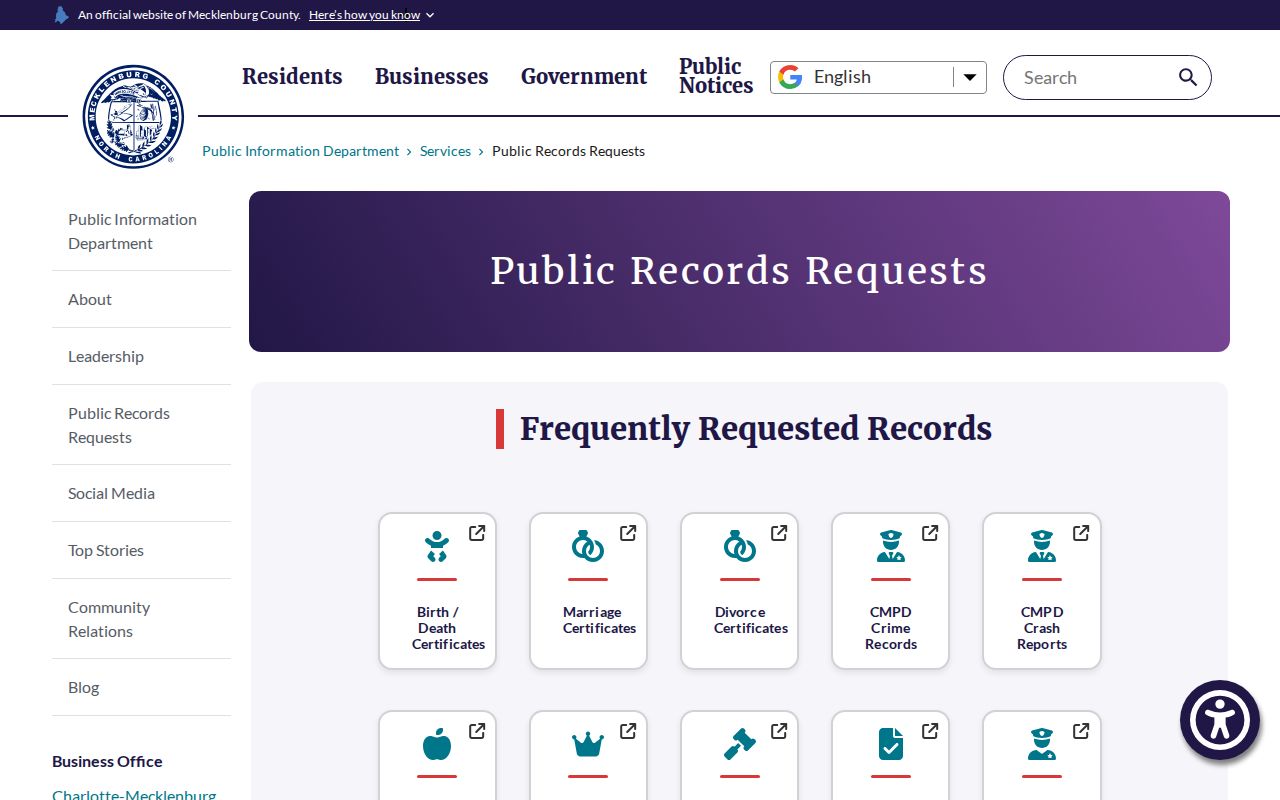
The portal should receive a focused request for an existing record, not a demand that MCSO create a new 24-hour or 72-hour compilation.
North Carolina Release Record Law
Chapter 132 of the North Carolina General Statutes defines public records broadly and favors copies at minimal or actual reproduction cost unless another law controls. G.S. 132-6 requires inspection at reasonable times and copies as promptly as possible. G.S. 132-6.2 permits a medium the agency can provide, allows a reasonable special charge for extensive technology or staff use, and does not force an agency to create or compile a nonexistent record.
Access has limits. G.S. 132-1.4 separates public arrest facts from criminal investigation and intelligence material. Some photographs can fall within the protected category even though listed arrest facts remain public. G.S. 132-11 protects sealed and federally protected information, Social Security numbers, and confidential juvenile records. G.S. 7B-3000 separately restricts juvenile court files. A missing record can therefore reflect confidentiality, sealing, expunction, the online time window, or search variation.
- Discharge
- The formal end of a custody or supervision status recorded by the responsible agency.
- Detainer
- A request by another authority for notice or temporary custody connected to a transfer.
- Expunction
- A court-ordered legal process that can remove eligible material from public systems.
- Post-release supervision
- Community oversight that follows certain North Carolina prison sentences.
Expunged Mecklenburg County Release Records
MCSO says its arrest and resident information normally remains online for three years from arrest or release. Before that period ends, the sheriff requires a judge-signed expunction order for removal from the inquiry. A sealed or expunged court file can also disappear from eCourts Portal. Absence is not proof that no arrest or release occurred, since the search could also miss an older record, a spelling variant, a juvenile matter, or a custody episode held by another agency.
For eligible North Carolina convictions, G.S. 15A-145.5 measures waiting periods from the later of conviction or completion of the active sentence, probation, or post-release supervision. That makes the end of supervision important. Jail release alone may not start the applicable clock. The statute has extensive offense, record, and procedure limits, so a date comparison by itself cannot establish eligibility.
Record correction begins with the source. MCSO controls its county inquiry, the Clerk controls official court records, and NCDAC controls state corrections data. A request should identify the exact record and the order or source detail supporting the change.
Find Mecklenburg County Released Inmates
Begin with the custody system that last held the person. County jail, state prison, federal prison, and immigration detention maintain different records. A released person may no longer appear when a current-custody filter is on. For MCSO, the key local step is turning Actives Only off. For NCDAC, an active probationer or parolee may already be in the community. For BOP, a past release date can mark the end of federal prison custody while supervision or another agency's custody continues.
- Open MCSO Inmate Inquiry, turn Actives Only off, and search the name. Add PID or JID when available.
- Read Released, status, prisoner type, committed date, bond or order data, and sentence rows on the matching record.
- If state prison or DAC supervision applies, use NCDAC and compare actual release, inmate status, and supervision status.
- Use eCourts for the case outcome, order, judgment, and disposition, while treating MCSO as the source for physical county departure.
- Check BOP or ICE when prisoner type or the local record points to federal or immigration custody.
- Submit a narrow records request when an online result is missing, too old, ambiguous, or insufficient for the needed fact.
The MCSO inmate search form visibly provides the Actives Only control used for a historical release lookup.
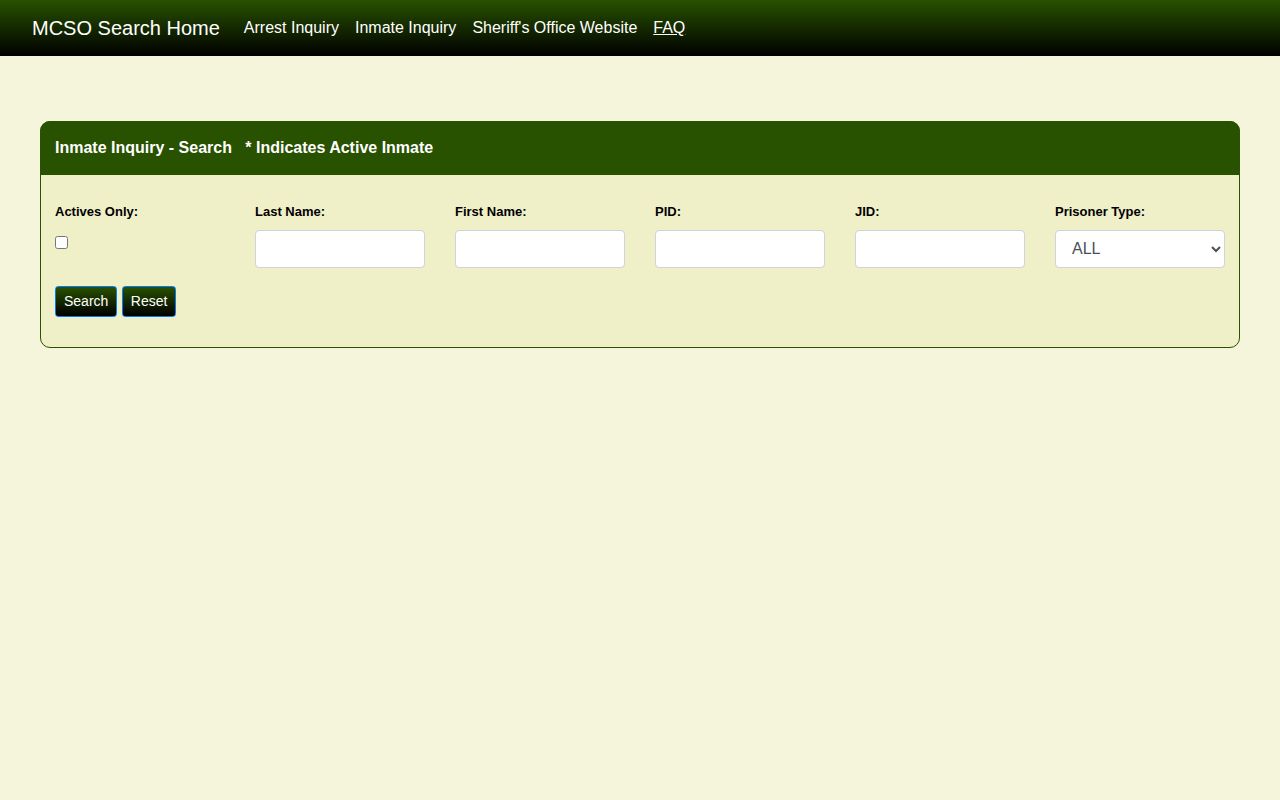
Leaving that control on can hide the historical record that confirms a county release.
NCDAC Mecklenburg Release Search
The North Carolina Department of Adult Correction search contains state prison, probation, and parole records back to 1972. It does not contain ordinary county-jail-only records. Search by offender number when known. Otherwise use a partial name with age or birth date, race, gender, and status with care. All selected criteria are combined, so remove filters if a sound search produces no match.
| Search field | How to use it | Released-person meaning |
|---|---|---|
| Status | Choose All when the current status is uncertain. | Active Probationer/Parolee may mean prison release into community supervision. |
| Offender number | Use the unique number for the fastest match. | Opens the individual correction history. |
| Name | Partial names are allowed; a sounds-like surname option is available. | Pair with another identifier to avoid a namesake. |
| Birth date or age | Use an exact date, range, or minimum and maximum age. | Helps separate people with similar names. |
| Sentence detail | Open the offender number from results. | Compare Actual Release Date, Projected Release Date, sentence status, and supervision dates. |
The NCDAC Offender Public Information Search presents these state correction filters.
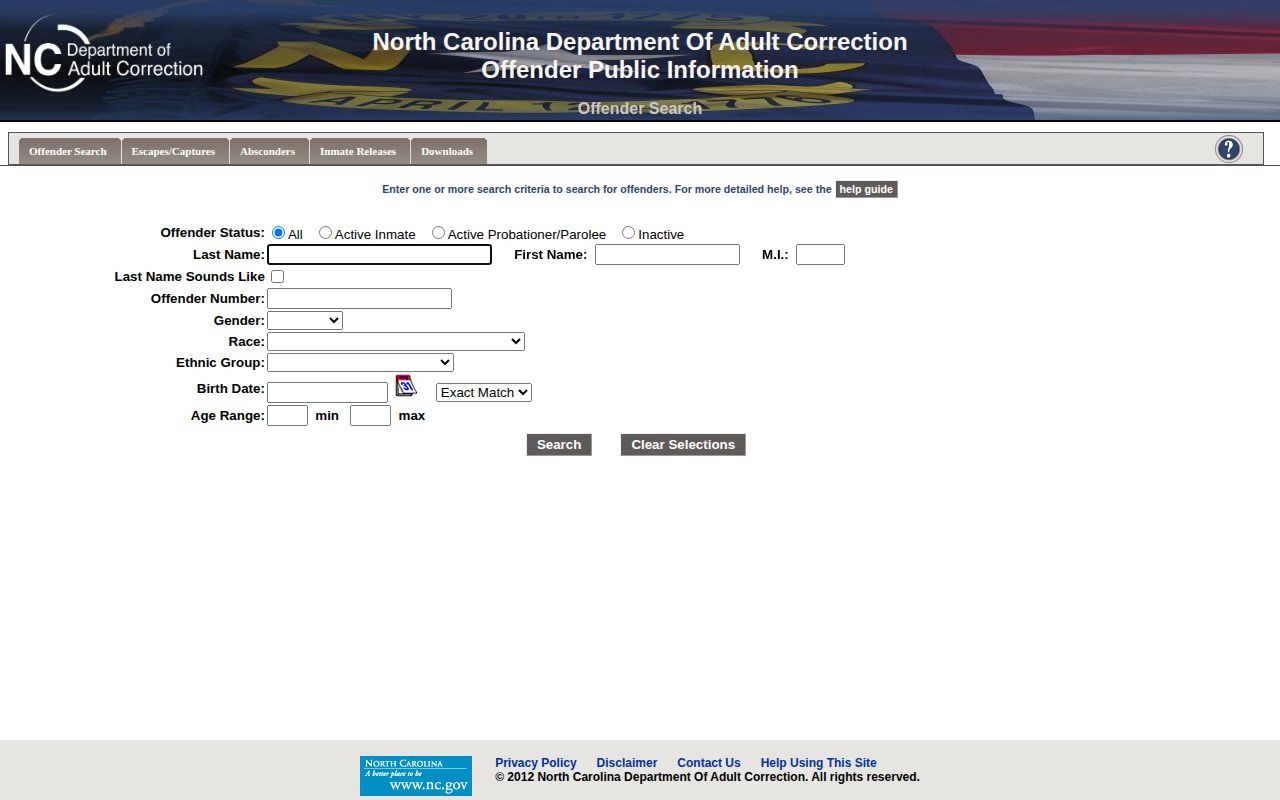
A county-jail release will not appear merely because the arrest happened in Mecklenburg; NCDAC must have held or supervised the person.
Note: Projected Release Date is an estimate, while Actual Release Date records a completed state custody event in sentence history.
Mecklenburg State-Prison Release List
NCDAC provides a second search by release county, year and month, or surname. Results can show offender number, name, release date, primary offense and qualifier, and type of release. Mecklenburg is selectable. The year menu observed on July 30, 2026 offered 2024 through 2026, but that live menu is not a permanent retention promise.
The label release county must stay intact. It is not necessarily the county of conviction, and it does not prove the person physically walked out of an MCSO facility. The tool covers NCDAC state-prison releases. MCSO has no verified named 24-hour or 72-hour feed. For that reason, the state list cannot be relabeled as a Mecklenburg jail release list.
The NCDAC Inmate Release Search displays the county and month route.
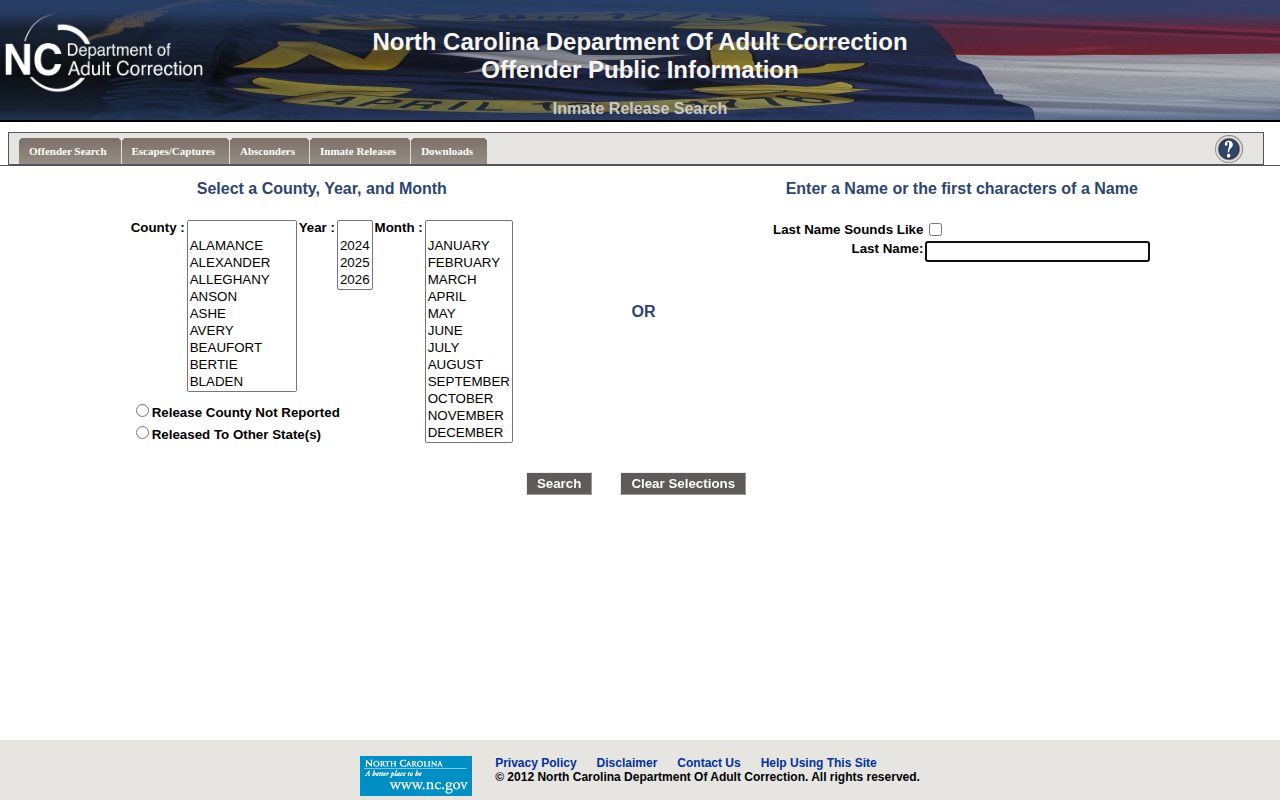
Use it for state prison releases associated with Mecklenburg, then open the individual NCDAC record for status and sentence details.
Mecklenburg Release Supervision and Reentry
North Carolina keeps probation, parole, and post-release supervision in the NCDAC public system. The North Carolina Post-Release Supervision and Parole Commission governs the applicable parole and post-release stage, while Sheriff Garry L. McFadden's office documents MCSO custody. Probation may occur without a prison term. Parole generally applies to older or otherwise parole-eligible sentences. Post-release supervision follows qualifying structured felony prison sentences. An Active Probationer/Parolee status can describe someone living in the community, not someone still in a prison cell.
Mecklenburg is Judicial District 26. The community supervision office is at 5701 Executive Center Drive, Suite 325, Charlotte, NC 28212, with phone 704-563-4117. Verify the correct person through the offender number and supervision status before asking the office to route a question. Mecklenburg County probation and parole records use the same public state system but describe forms of oversight that should not be collapsed into one status.
Release support follows different rules. MCSO Re-Entry Support Services meets people at the release post and may provide a basic-needs backpack. Mecklenburg County Re-Entry Services accepts voluntary referrals before release or within one year after return from local, state, or federal incarceration and helps route identification, treatment, health, education, medication, and peer-support needs.
Mecklenburg Release and Court Records
Mecklenburg moved to eCourts on October 9, 2023. Portal supplies public case data, docket events, dates, and available document images. Compare the correct criminal case's charge, bond or order, judgment, sentence, and disposition. A disposition may explain why release should occur, but it does not show the minute MCSO staff finished processing the physical departure.
For a pre-cutover criminal document missing online, contact the appropriate Mecklenburg Clerk division. Identify the record type, party names, and file number when known. The Clerk can provide official copies when the online view is not enough. Public onsite access is available Monday through Friday, 9 a.m. to 5 p.m., at the Mecklenburg County Courthouse, 832 East Fourth Street in Charlotte.
The Mecklenburg County Judicial Branch page documents the local hours and old-versus-new record route.
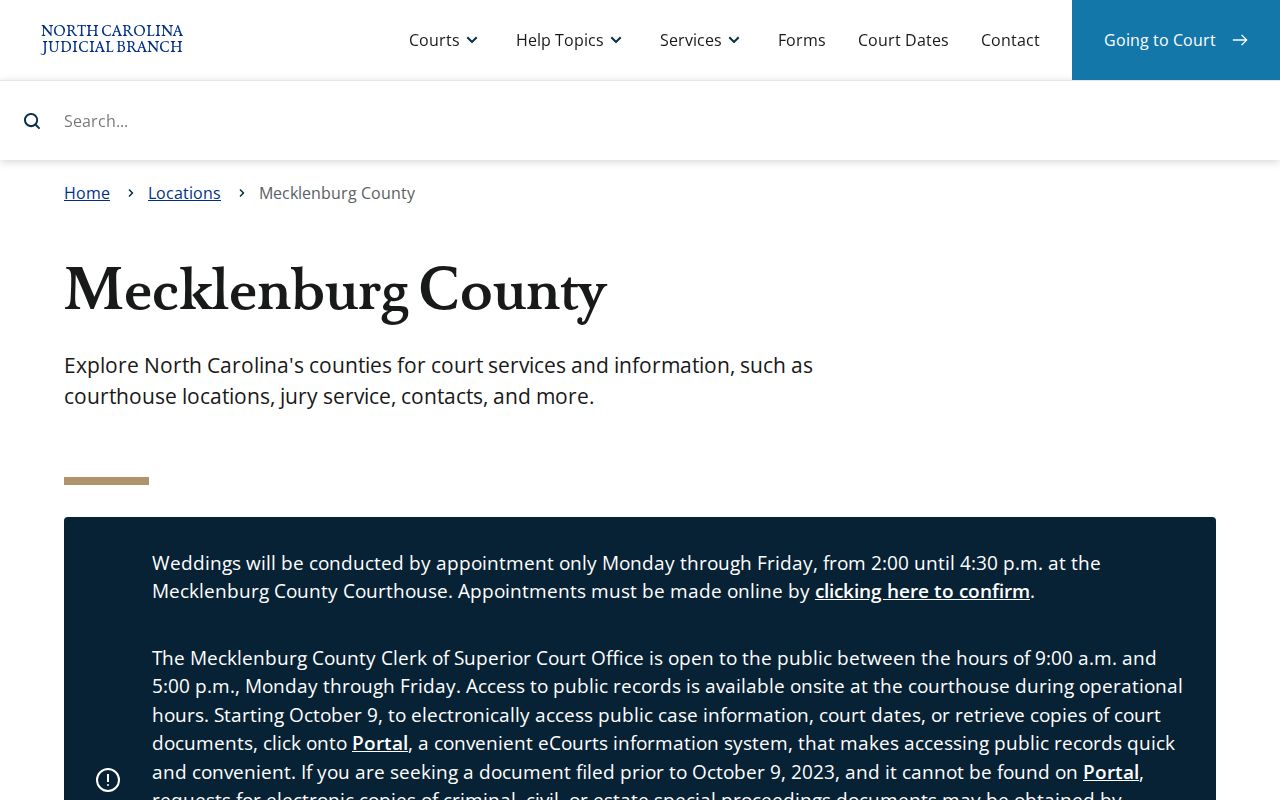
Use the court source for case outcome and MCSO for the county custody exit, since neither record answers both questions alone.
Mecklenburg County Release Alerts
North Carolina's statewide notification service is NC SAVAN, also reached through VINELink. It supports web, mobile, and telephone access at 1-877-627-2826, with phone, text, email, and TTY channels described by official sources. Registration follows one specific person and selected custody events. A phone registration uses a four-digit PIN to acknowledge a later alert.
MCSO also provides a local VINE telephone route at 1-800-247-9658. Search a committed resident by PID or last and first name, register a phone number and PIN, and listen for a release or transfer call. Calls can continue for up to 24 hours until the correct PIN acknowledges the alert. The local service excludes an arrestee who bonds out before commitment. It is an alert channel, not a permanent proof record.
Follow any alert with the responsible agency's record. MCSO confirms Mecklenburg County release, NCDAC confirms state actual release and supervision, BOP confirms federal prison status, and ICE covers its own current or recent detention window. A VINELink inmate search is useful for setting one-person notifications, while the agency record supplies lasting context.
Mecklenburg ICE Release Transfers
MCSO prisoner types distinguish ICE or 287G, federal or USMS, and BOP custody. When the local Released field marks a handoff, it may show only that Mecklenburg County custody ended. An ICE detainer asks for notice of an expected release and may request that the local agency hold the person for up to 48 hours so ICE can take custody. A detainer is not itself a deportation order.
ICE's Online Detainee Locator uses a nine-digit A-number, with leading zeroes where directed, or exact name, birth date, and country of origin. Official ICE guidance says it covers current detainees and people released from ICE custody within the last 60 days. Upload delay, safety exclusions, discretion, and the short window mean no result is inconclusive. The locator does not search children under 18.
No dedicated ICE detention center was found in Mecklenburg County's official facility sources. That does not rule out a transfer from MCSO. Compare the local release time with the ICE result and, when needed, request the destination or receiving-agency field from Records and Release.
Mecklenburg Federal Release Records
The Bureau of Prisons locator covers federal inmates from 1982 forward. Search by BOP, DCDC, FBI, or INS number, or by name with optional age, race, and sex. A past date paired with Released or Not in BOP Custody and no listed facility means BOP custody ended. It does not prove that federal supervision or custody in another justice system ended.
MCSO may hold a federal resident for the U.S. Marshals Service even though no BOP-operated prison was found in Mecklenburg County. The county record can show a transfer before the later BOP record. No public USMS historical release locator comparable to BOP was found, so a federal docket or direct agency inquiry fills that gap. A future BOP date is projected and may change through federal credit calculations.
The BOP Inmate Locator provides the national federal custody search assigned to this release path.
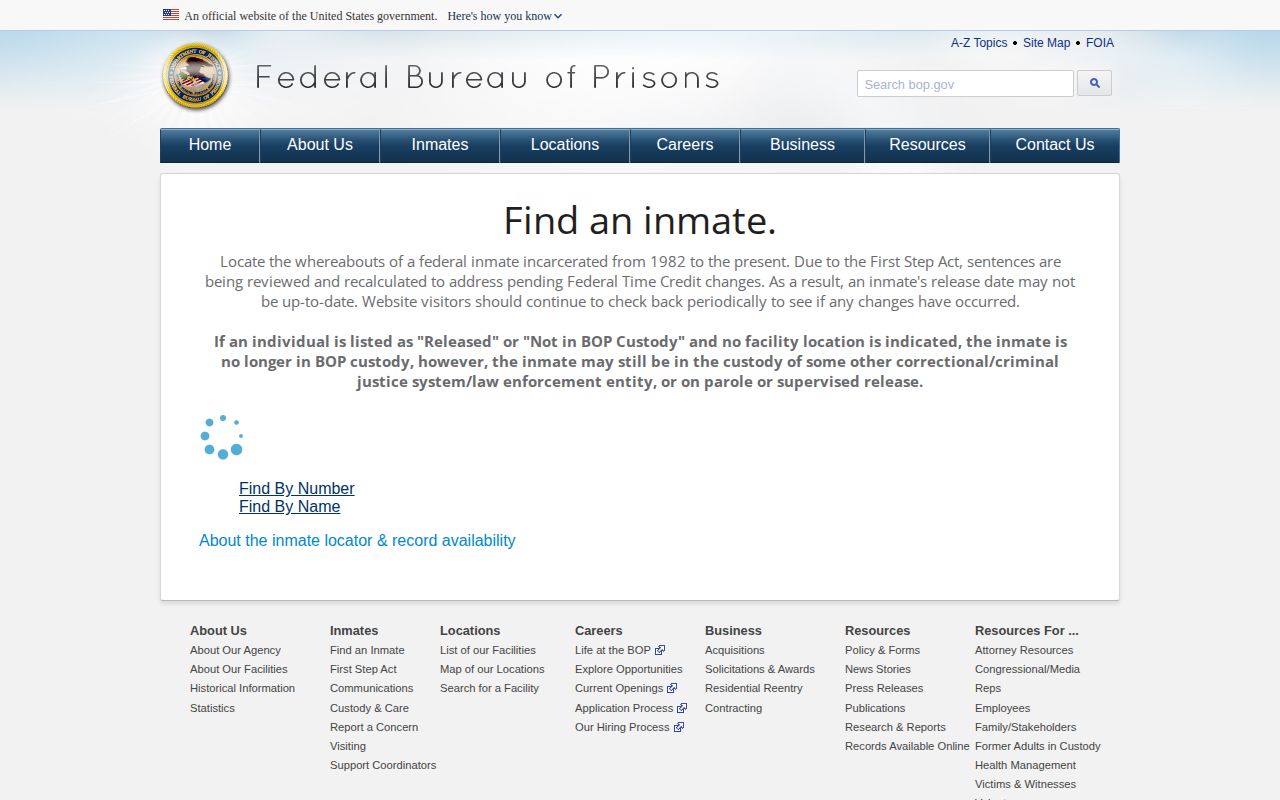
Read the BOP date beside the MCSO transfer entry and court docket to build the correct custody timeline.
Mecklenburg Release Lookup by Custody
The same name can appear in several systems because each agency records only its own custody or supervision. Use the source whose legal custody actually ended. Then check the next source when a transfer, supervision status, or court order points beyond that event.
| Situation | Controlling public source | Key result |
|---|---|---|
| Still in MCSO custody | MCSO inquiry with active records | Active status, custody location, committed date |
| Released from county jail | MCSO inquiry with Actives Only off | Released date and time |
| Released from state prison | NCDAC offender detail | Actual Release Date and supervision status |
| Case outcome or release order | eCourts and Mecklenburg Clerk | Disposition, judgment, order, sentence |
| Federal prison release | BOP national locator | Past release date and custody label |
| ICE current or recent custody | ICE ODLS | Current custody or recent release within its limited window |
NC SAVAN and MCSO VINE add alerts, but they do not replace the release record. The North Carolina sex offender registry applies only to a person with a registration duty and is not a general jail-release source.
Note: A transfer line should be followed into the receiving system before describing the person as back in the community.
North Detention Release Records
Detention Center North has two documented eras. MCSO says the former adult jail became Juvenile Detention Center North on December 1, 2019 and served ages 15 through 17. MCSO newsroom entries from May and June 2026 then describe reopening tied to adult overcrowding and possible federal residents. Those official pages capture a transition, so no precise adult reopening date, capacity, or resident mix should be assumed without a newer source.
Adult North records use the same MCSO inquiry and central Records and Release workflow. Juvenile court records are generally confidential under G.S. 7B-3000 and must not be routed through a public adult released-inmate lookup. A federal resident's MCSO departure may be a USMS or BOP transfer rather than a community release.
The MCSO newsroom is the source for the 2026 reopening reports.
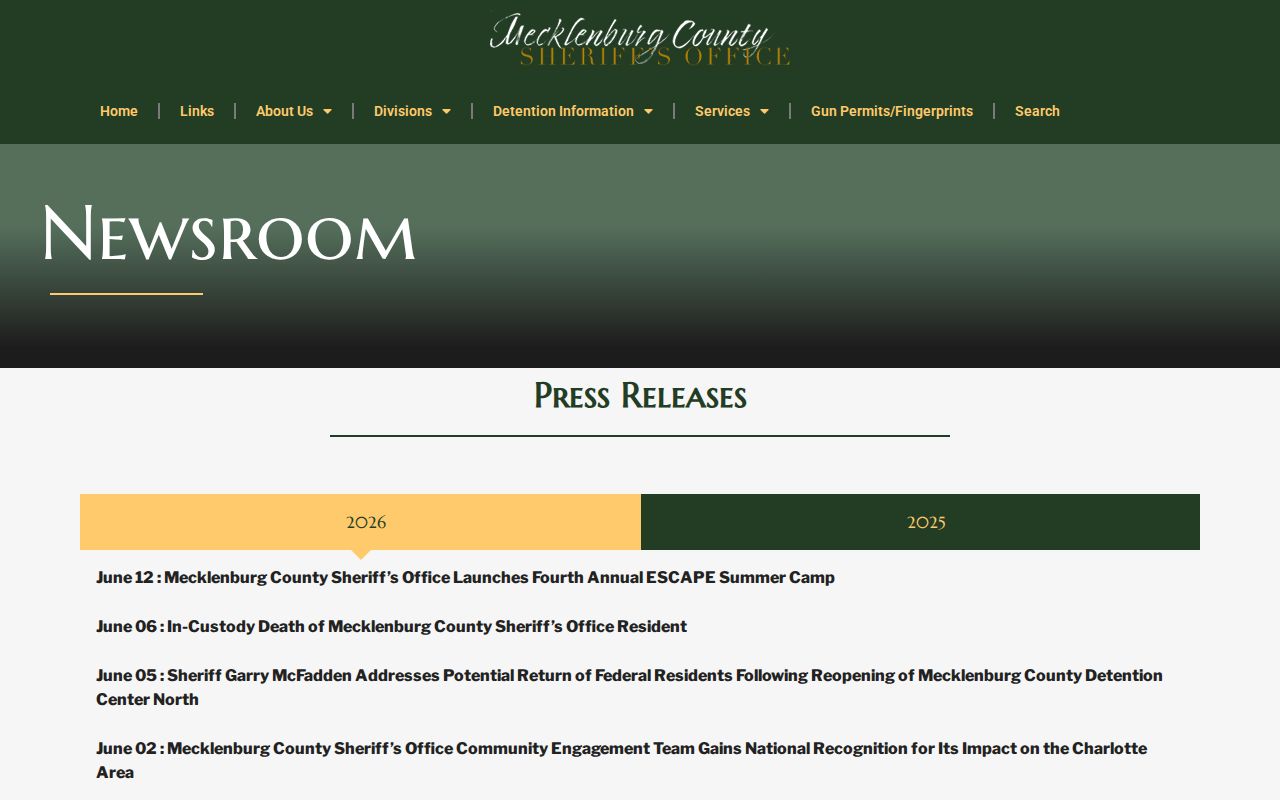
Date the facility status against current MCSO news before interpreting a North custody or release entry.
Mecklenburg County Release Facilities
Two MCSO sites appear in the resolved facility map. Central is the adult county pretrial hub and contains the Arrest Processing Center, Records and Release, centralized property, and release-area account closeout. North is in the documented 2026 transition between juvenile use and renewed adult, overflow, or possible federal-resident functions.
- Mecklenburg County Detention Center Central, 801 East Fourth Street, Charlotte, NC 28202, phone 980-314-5200. County releases and transfers are confirmed through MCSO.
- Mecklenburg County Detention Center North, 5235 Spector Drive, Charlotte, NC 28269, phone 980-314-5500. Adult entries use MCSO; juvenile records remain confidential.
- Arrest Processing and Records and Release operate inside Central at 801 East Fourth Street, phone 980-314-5100. This is an operational unit, not a third residential facility.
No active NCDAC prison, BOP-operated prison, or dedicated ICE detention center was found in the county's reviewed official directories. State and federal sentences may still be served elsewhere, and MCSO may hold federal residents locally. Facility location and custody authority must not be treated as the same fact.